
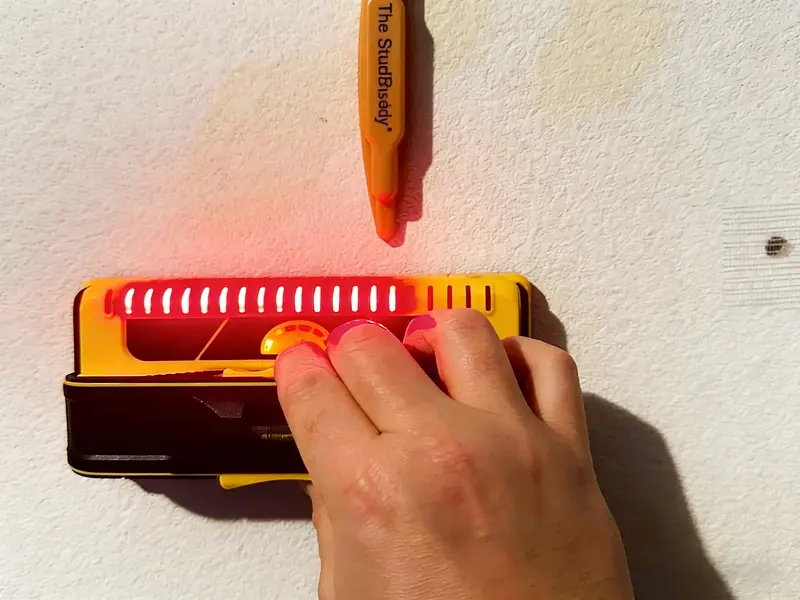
Hanging a 100-lb commercial display or a custom kitchen cabinet on 1/2-inch drywall requires anchoring directly into the geometric center of a 1.5-inch nominal wood stud. Missing that center by just 0.5 inches drastically reduces the shear strength of the lag bolt, risking catastrophic failure under load.
The hardware industry relies on two primary detection architectures to solve this: rare-earth magnetic detection and capacitive multi-sensor arrays (a technology popularized by brands like Franklin Sensors). Here is the technical breakdown of how these hardware designs perform under actual site conditions.
The Mechanics of Magnetic Detection
Magnetic finders do not detect wood or structural mass. They utilize N50 or N52-grade neodymium magnets to locate the steel drywall screws or nails securing the gypsum board to the stud.
Hardware Limitations: A standard #6 drywall screw head is roughly 0.33 inches in diameter, buried under joint compound and 1/2-inch to 5/8-inch of drywall. Magnetic force degrades exponentially with distance due to the inverse-square law. If the drywall installer countersunk the screw too deeply, the magnet will miss it.
More importantly, drywall installers frequently drive screws off-center. Pinpointing a screw head guarantees you have found metal; it does not guarantee you have mapped the structural center line of the stud.
Capacitive Multi-Sensor Arrays
Advanced electronic stud finders discard magnets entirely. They rely on an array of capacitive sensor plates (typically 7 to 13 individual nodes) spread across a 4-inch to 6-inch horizontal printed circuit board (PCB). These sensors emit an electric field into the wall cavity and measure the dielectric constant of the materials behind the surface.
The Physics of Detection: Air has a dielectric constant of roughly 1.0. Standard gypsum (drywall) registers around 2.5 to 3.0. Solid structural wood (like Douglas Fir or Pine) sits between 3.0 and 4.0.
As the multi-sensor array slides horizontally across the wall, the internal microcontroller (MCU) calculates the capacitance delta across all nodes simultaneously. When the sensors detect a localized spike in density, the corresponding LEDs illuminate, displaying the exact 1.5-inch footprint of the stud.
Head-to-Head Technical Comparison
1. Calibration and Latency
Traditional single-sensor electronic models require the user to place the tool on a "hollow" wall section to establish a baseline capacitance. Placing the tool over a stud initially causes a calibration fault, resulting in erratic beeping.
Multi-sensor models resolve this. By sampling the wall continuously across a wide base, the MCU cross-references the sensor plates against each other, self-calibrating in real-time. The processing latency is under 50 milliseconds, allowing for a "press and scan" workflow with zero setup time.
2. Detection Depth and Material Density
Magnetic finders generally max out at 0.75 inches of penetration for standard steel screws.
Capacitive sensors operating in "Deep Scan" mode increase the electrical field amplitude, penetrating up to 1.5 inches (38mm) to scan through double-layered Type X fireboard or thicker architectural finishes.
Neither technology excels on 1920s lath-and-plaster walls due to the extreme, unpredictable density variations of the mortar. However, capacitive models offer a marginally higher success rate when analyzing broader density trends compared to magnets, which fail entirely if the lath nails are buried too deeply.
3. AC Wire Hazard Detection
Drilling blindly into a stud bay carries the risk of striking live electrical lines. Premium capacitive scanners integrate dedicated antennas for AC wire warning systems. These detect the 50/60Hz electromagnetic field emitted by live, unshielded 110V/220V wiring up to 2 inches deep, alerting the operator before the drill bit penetrates the wall. Magnetic tools provide zero electrical warning.
The Professional Installation Workflow
Mapping the structural anchor point is only phase one of a commercial installation. Accuracy must be maintained throughout the sequence.
Once the capacitive scanner maps the stud center, contractors utilize a high-precision digital level (calibrated to a tolerance of ±0.1° at 0° and 90°) to align the heavy-duty mounting brackets perfectly horizontal.
If the initial deep scan reveals abnormal, localized density patches—often indicating trapped moisture behind the drywall—site engineers will deploy a pinless moisture meter to measure internal hydration levels. Any reading above a 15% Wood Moisture Equivalent (WME) requires structural remediation before mounting heavy fixtures.
OEM/ODM Manufacturing for Electronic Measuring Tools
Stop settling for low-margin, generic hardware. eOUTIL engineers and manufactures high-precision capacitive wall scanners, digital levels, and moisture meters for global tool brands. Leverage our dual production bases in China and Vietnam for tariff-free import advantages, low MOQ prototyping, and factory-direct pricing.
Discuss Custom Manufacturing Specs