
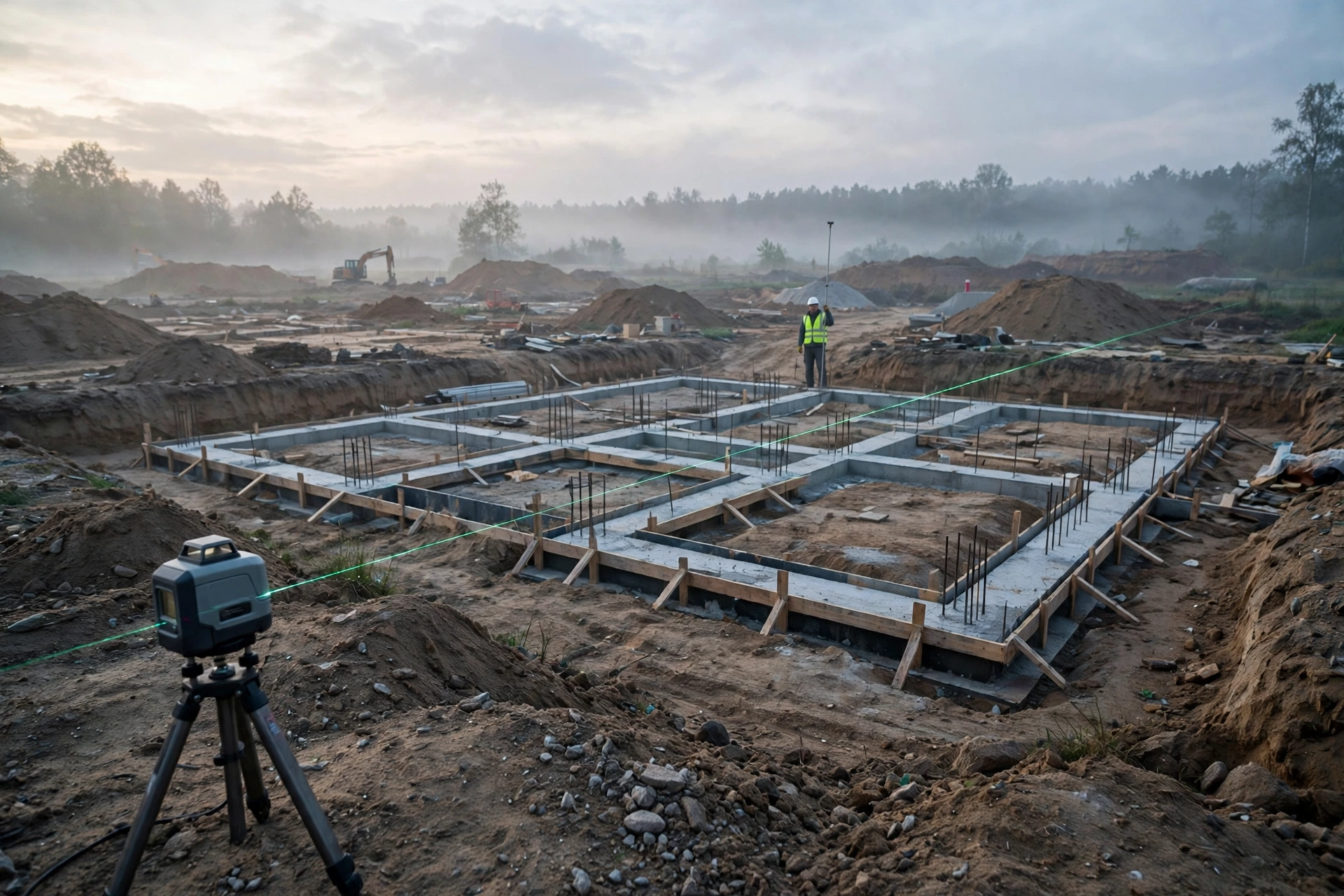
A rotary laser level turns a single spinning beam into a level reference plane that covers a whole job site. One instrument on a tripod can set grades for a foundation, level a suspended ceiling and check a drainage fall, all from the same setup. The newest generation, launched in late 2026, pushes that idea further: tighter accuracy, longer working diameters, digital slope control from a phone, and batteries that last a full working week. This guide explains what to look for, using the latest releases from Huepar and Bosch as the benchmarks, and where a different tool still wins.
What a rotary laser level actually does
Inside the housing, a laser diode projects a beam onto a spinning head, sweeping a flat 360-degree plane around the instrument. A receiver clipped to a grade rod picks up that plane outdoors, where the beam itself is invisible in daylight, and beeps as the rod moves above or below level. Most models also work vertically, projecting a plumb plane for partition walls and layout, with up and down plumb points.
That reach is what separates a rotary laser from a line laser or a digital level. Line lasers suit interior rooms; a digital level measures a single spot. A rotary laser is the tool for foundations, earthworks, road grading, drainage and large interiors — anywhere the reference has to travel further than an arm's length. For short-range spot checks on site, a rugged digital level remains the lighter option.
Accuracy and self-levelling: the numbers that matter
Accuracy is quoted as a deviation over a distance, so always read the distance attached to the figure. According to Huepar, its new flagship RL450HVG3-2S delivers ±1/32 in. accuracy at 33 ft (0.75 mm at 10 m). Bosch states ±1.5 mm at 30 m for its new PRO GRL18V-3-31G. The figures are close; the difference is the distance they are measured over, which is why comparing headline numbers without the range is meaningless.
Self-levelling range decides how rough the setup can be. The Huepar RL450HVG3-2S self-levels within ±5° in 18 seconds or less, according to the manufacturer. The Bosch GRL18V-3-31G offers a self-levelling range of ±15%, which suits earthworks, concrete foundations and landscaping, where a tripod rarely sits on flat ground. Both instruments warn when they are disturbed: Huepar's Tilt Alert sounds an audible alarm and shows an on-screen warning in self-levelling and manual modes when the instrument is knocked.
Range, receivers and working diameter
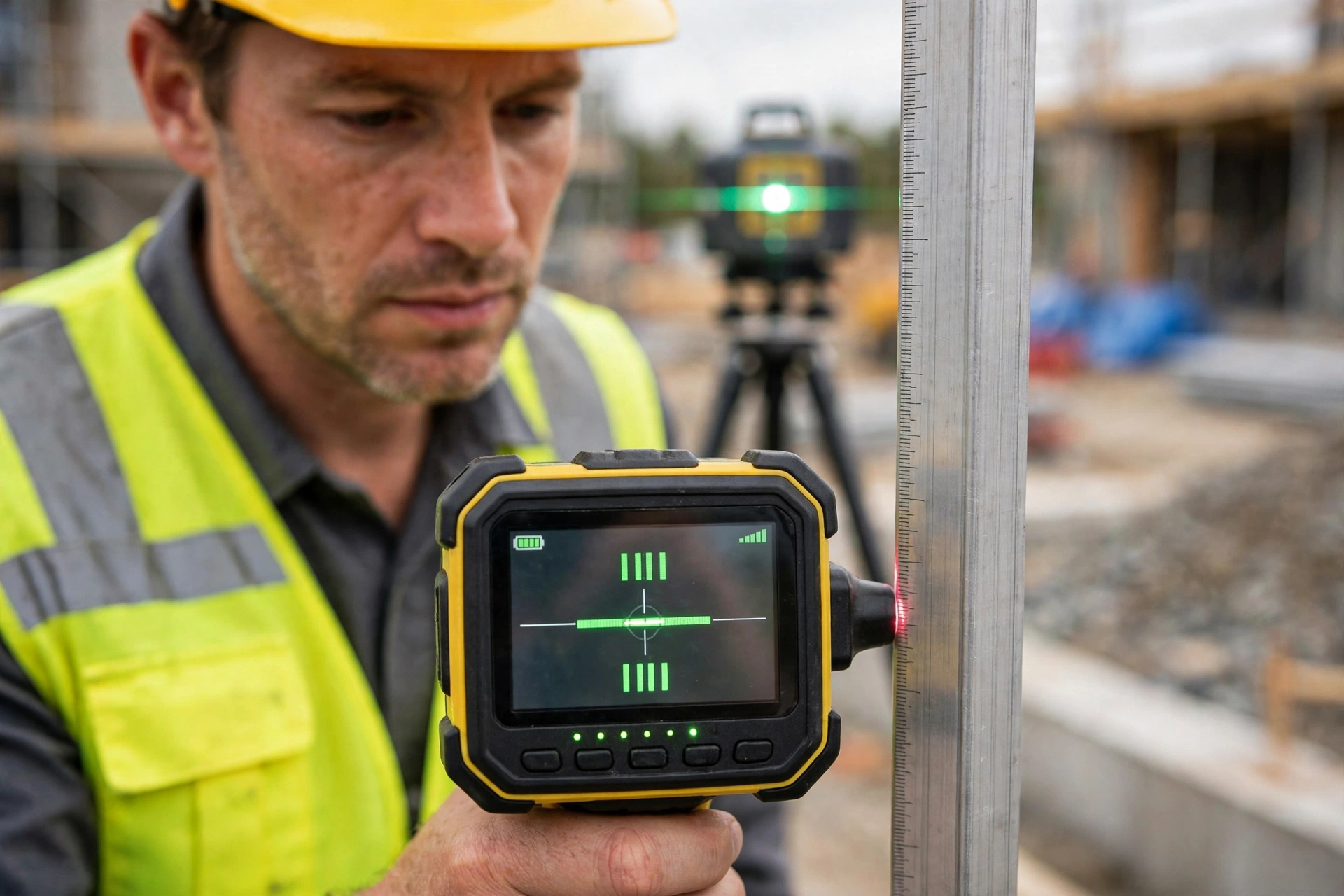
A laser receiver reads the beam on a grade rod where the beam itself is invisible in daylight.
A rotary laser's headline range means little without its receiver. According to Huepar, the RL450HVG3-2S covers a working diameter of up to 2,600 ft (800 m) with the included receiver; without it, the beam is visible up to 400 ft (120 m) in dim conditions. Bosch pairs its new 18V rotaries with dedicated receivers — the LR3-2 for the GRL18V-3-31G and the LR 45 for the slope model — plus a WM5 steel wall mount with ±45 mm height adjustment and a BB1 aluminium batter board holder for objects from 15–80 mm.
The practical point is simple: budget for the receiver as part of the system, not as an accessory. Outdoors, the beam is a reference the eye cannot see, and the receiver is the instrument that reads it.
Slope and grade: the feature that separates the new generation
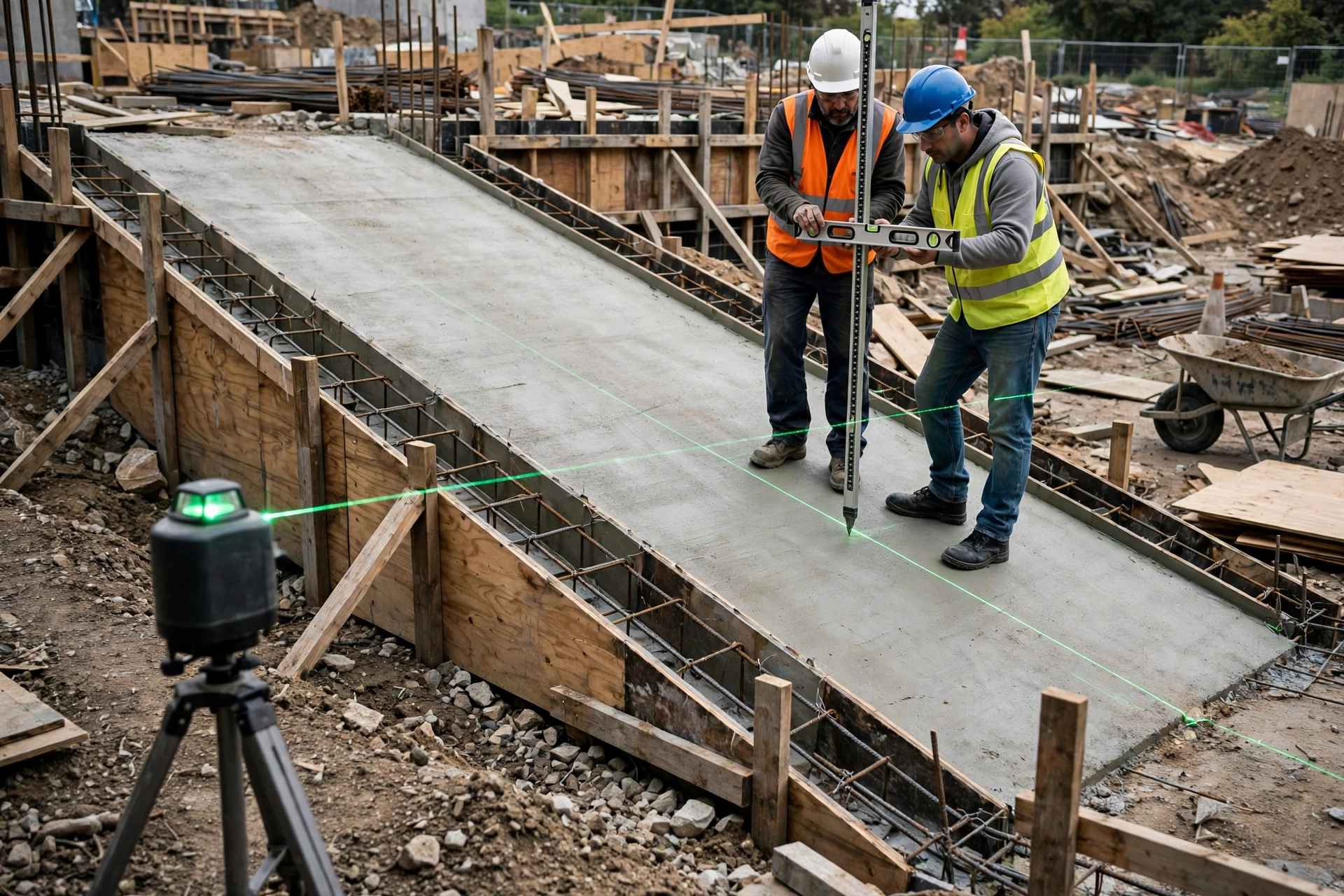
Checking the grade of a sloped concrete ramp against a rotary laser's reference plane.
Digital slope control is the clearest step forward in the 2026 generation. The Huepar RL450HVG3-2S accepts digital X/Y slope entry up to ±5° (±8%) per axis, set from the unit, the remote control or a Bluetooth app, with single-axis slope accuracy of ±1/9 in. at 33 ft, according to Huepar. It also aligns itself automatically to the receiver, with an alignment range up to 98 ft (30 m) and accuracy of ±1/25 in. at 33 ft — useful when a grade has to run to a distant benchmark rather than to the instrument's own level plane.
Bosch takes the same idea further on its slope model. The PRO GRL18V-4-34CVG offers slope adjustment of up to ±15%, supported by a patented LED indication and a control panel of bi-colour segment LEDs readable from a distance. It is fully controllable through the Levelling Remote App, which handles slope adjustment plus sweep angle selection, speed and sleep mode. According to Bosch, it suits single-axis slope applications such as ramps with an incline of up to 15%, and indoor work on larger sites such as suspended ceilings and partition walls.
Power, toughness and staying on site
A rotary laser earns its keep by running all day, in dust and rain. Both new models carry IP66-rated protection: the Huepar RL450HVG3-2S is rated IP66 for dust and water protection, and Bosch states the same IP66 certification for the GRL18V-3-31G, covering complete dust protection and powerful water jets. Drop resistance is specified plainly too: Huepar rates the RL450HVG3-2S to 4.9 ft (1.5 m), and 6.6 ft (2 m) on a tripod, while Bosch fits the GRL18V-3-31G with protective handles and a reinforced top cap for shock resistance from a 1.5 m tripod tip-over.
Batteries are where the two brands diverge. Huepar's dual-battery system delivers up to 35 hours of runtime, against up to 14 hours on its earlier RL300HVG. Bosch's Dual-Power-Source function lets both new models run on an 18V lithium-ion battery or on four C-alkaline batteries via the BA 18-C adapter, and both rotaries sit in Bosch's Professional 18V System, with the multi-brand AmpShare alliance extending battery compatibility beyond Bosch's own tools.
Beam colour matters for visibility. Huepar uses a Class 3R green laser (505–540 nm, under 5 mW) for what the company describes as a brighter, highly visible beam. Bosch uses a green laser diode on both models for optimal beam visibility in interior applications. Smaller details add up over a working life: Huepar ships an Apple-certified Huepar Tag tracker compatible with Apple Find My and Google Find Hub, and backs the instrument with a 5-year warranty and lifetime technical support.
When a rotary laser is the wrong tool
A rotary laser needs line of sight, and some elevation jobs do not have it. For those, a hydrostatic altimeter measures height through a pressurised water column instead of a beam. Technidea's ZIPLEVEL PRO-2030, featured in AQUA Magazine's November 2026 roundup, uses what the company calls patented, pressurised, hydrostatic technology that eliminates bubble bleeding for precise elevation measurements over unlimited ranges, without calculations, line of sight, distance or earth curvature error. According to the roundup, the self-cased instrument sets up in seconds and often completes measurements faster than a rotary laser setup. The PRO-2030 was introduced in July 2026 and won a 2026 World of Concrete Innovative Product Award (Experts' Choice). It is designed and built in the United States for pool and spa contractors, construction professionals, inspectors, engineers and surveyors.
The same logic applies at the other end of the scale. For a quick level check on a single run of brickwork or a piece of plant, a rotary laser is overkill; a rugged digital level does the job faster. Our guide to IP54 digital levels for outdoor construction covers what to look for there.
A short buyer's checklist
- Accuracy at a stated distance. Compare ±mm figures only at the same range.
- Working diameter with the receiver. Check whether the receiver is included.
- Slope range and control. Digital X/Y slope and app control matter for grading; ±15% covers ramps.
- Battery system and runtime. Dual power or a shared 18V platform avoids downtime.
- IP rating and drop rating. IP66 and a stated tip-over height are the minimum for site work.
- Support and warranty. A 5-year warranty and lifetime technical support are worth weighing against a lower price.
The 2026 generation converges on the same answer: green beams, app-controlled slope, dual power and IP66 toughness. Choose by the job — grading and drainage, large interiors, or elevation work without line of sight — and the specification sheet will tell you which of these instruments fits.